2026 Best Jeans Rivet Button Manufacturers for Global Buyers

Time:2026-09-21 Author:Sophia
0%

Choosing the right Jeans Rivet Button manufacturer can shape denim quality, production stability, and brand reputation in 2026. Global buyers need more than attractive catalogs or low quotations. They need suppliers with proven manufacturing experience, consistent material control, and transparent communication across borders.

A reliable manufacturer should explain whether each button uses brass, iron, zinc alloy, or recycled materials. The supplier should also provide clear plating options, color references, dimensional tolerances, and packaging details. Small differences matter. A poorly fitted rivet can loosen during washing or damage denim panels during pressing. Experienced factories usually support sample development, pull-strength testing, salt-spray checks, and batch inspections before shipment. They should also explain minimum order quantities, tooling charges, production schedules, and export documentation without vague promises.

Evidence matters most. Look for factory audits, quality records, product samples, and traceable inspection reports. Certifications can support confidence, but they should match the actual product and market requirements. Buyers should verify claims independently. No supplier is perfect. Even established manufacturers may face plating variation, delayed raw materials, or communication gaps during peak seasons. That reality deserves attention.

This guide evaluates leading Jeans Rivet Button manufacturers through practical criteria, including production capacity, customization ability, quality consistency, pricing transparency, sustainability practices, and after-sales support. It is designed for wholesalers, denim brands, garment factories, and sourcing teams seeking dependable long-term partnerships. The goal is not to recommend the cheapest option. It is to identify manufacturers capable of delivering secure, attractive, and repeatable results for global denim production.
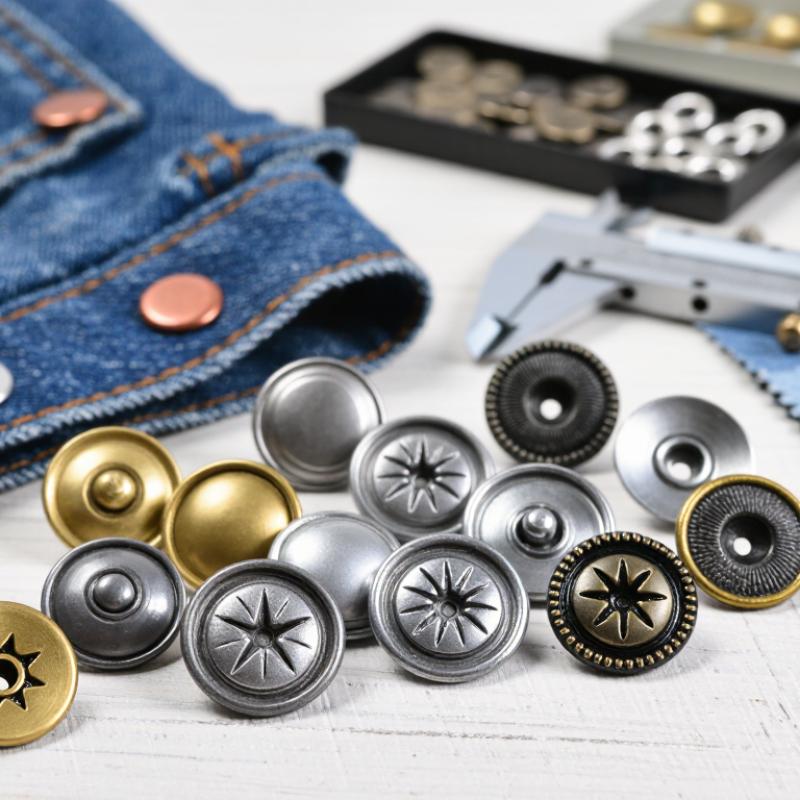
2026 Best Jeans Rivet Button Manufacturers for Global Buyers

Jeans Rivet Button Market Scope: 2026 Demand and Global Buyer Trends

In 2026, global demand for jeans rivet buttons is moving toward durable, traceable, and flexible sourcing. Denim manufacturers want components that survive repeated washing, pressing, and daily wear. Rivet buttons must resist corrosion, deformation, and color fading. Small details matter.

Experienced buyers now request material declarations, coating records, and batch-level inspection reports. Stainless steel and recycled metal options are gaining attention, especially among manufacturers with sustainability targets. Nickel-free finishes also support broader market access. However, “recycled” claims require evidence, not attractive wording. Reliable suppliers should provide samples, dimensional drawings, tensile test results, and controlled production records. Factory audits remain useful, though one visit cannot prove every future batch.

Global buyer trends show stronger interest in lower minimum order quantities and faster prototype development. Online sampling, digital catalogs, and video inspections reduce early communication delays. Buyers from Europe, North America, and emerging Asian production centers often compare lead time, packaging quality, and replacement support together. Price still matters. It is not everything. A cheap rivet that loosens during washing can create returns, rework, and damaged customer trust. Some forecasts appear confident, yet fashion demand can change quickly. Manufacturers may need several plating options, adjustable tooling, and stable backup materials. This flexibility is increasingly important for private-label denim programs and seasonal collections.

Rivet Button Materials: Brass, Zinc Alloy, Stainless Steel, and Recycled Metal

For global buyers in 2026, rivet button material directly affects durability, appearance, and production consistency. Brass offers a warm tone and reliable forming performance. It suits premium denim and develops a natural patina over time. Zinc alloy supports detailed shapes and competitive pricing, but thin plating may wear quickly at pocket edges. Stainless steel delivers strong corrosion resistance, especially for humid transport or frequent washing. Recycled metal can reduce material waste, although color variation and traceability need careful control.

Factory evaluation should include pull-off strength, surface adhesion, dimensional tolerance, and salt-spray testing. Request samples from the same production line, not only showroom pieces. Compare button weight, cap alignment, and burr control under bright inspection light. A recycled alloy may perform well, yet inconsistent batches remain a practical concern. No material is perfect. Small plating defects can become visible after repeated washing.

Tips: Match material choice with denim weight, wash process, and target price. Ask manufacturers for composition records and recycled-content evidence. Test finished garments through several wash cycles before approval. Check the setting machine too; excellent buttons can still fail with incorrect pressure. For export orders, confirm packaging protects surfaces from moisture and friction. A short pilot order often reveals problems that specifications miss.

2026 Best Jeans Rivet Button Manufacturers for Global Buyers

Rivet Button Materials: Brass, Zinc Alloy, Stainless Steel, and Recycled Metal

Evaluation Dimension Brass Zinc Alloy Stainless Steel Recycled Metal
Typical alloy or material basis Copper-zinc alloy; composition varies by grade Usually zinc die-casting alloy, such as Zamak 3 or equivalent Common grades include austenitic 304 or 316 stainless steel Recovered brass, zinc, steel, or mixed non-ferrous metal; grade must be specified
Approximate density 8.4–8.7 g/cm³ 6.6–6.8 g/cm³ 7.7–8.0 g/cm³ Depends on the recovered alloy and composition
Relative button weight Medium to high Lower than brass and stainless steel for the same volume Medium to high Varies according to the selected metal
Corrosion resistance Good in normal apparel conditions; finish and environment affect tarnishing Moderate; protective plating or coating is commonly used High; 316 generally offers better chloride resistance than 304 Depends on alloy consistency, contamination, and surface treatment
Magnetic behavior Generally non-magnetic Generally non-magnetic 304 and 316 are generally non-magnetic when annealed, but forming may increase magnetism Depends on the recovered metal type
Manufacturing suitability Stamping, machining, and various decorative finishes Efficient die casting for detailed shapes and high-volume production Stamping, machining, and durable structural components Process depends on verified alloy content and scrap preparation
Common appearance options Natural gold tone, antique, nickel, black, and other plated finishes Nickel, antique, gunmetal, black, brass-tone, and colored coatings Bright, brushed, polished, matte, or PVD-coated surfaces Appearance varies; finishing may be required for consistent color
Best fit for jeans Premium denim, vintage styling, and traditional button designs Cost-sensitive collections and complex decorative designs Workwear, outdoor denim, and products requiring high durability Collections with documented recycled-content objectives
Recycled-content requirement Must be confirmed by alloy-level documentation Must be confirmed by supplier declaration or chain-of-custody evidence Recycled content can be specified, but percentage varies by production route Request the exact percentage, source, and verification method
Key quality checks for global buyers Alloy composition, plating adhesion, nickel release, burrs, and pull-off strength Casting porosity, coating adhesion, dimensional accuracy, nickel release, and pull-off strength Grade verification, corrosion testing, surface defects, dimensions, and pull-off strength Material traceability, composition, contaminants, recycled-content evidence, and performance tests
Recommended buyer documentation Material certificate, restricted-substance test report, finish specification, and inspection report Alloy declaration, coating specification, restricted-substance test report, and inspection report Stainless grade certificate, corrosion or finish specification, and inspection report Recycled-content declaration, chain-of-custody records, alloy certificate, and inspection report
Buyer note: Material performance varies by alloy grade, button construction, plating, washing process, and production quality. Confirm the final specification with a pre-production sample and test report before bulk purchasing.

Quality Standards: ISO 9001, ASTM Testing, and 0.5 μg/cm²/Week Nickel Limits

Global buyers assessing 2026 jeans rivet button manufacturers should treat ISO 9001 as process evidence, not a guaranteed product result. The ISO Survey 2022 recorded 1,265,216 ISO 9001 certificates worldwide, showing the standard’s broad industrial adoption. However, buyers still need batch records, material declarations, and corrective-action data. A certificate alone cannot reveal weak plating or inconsistent press-fit performance.

Nickel control deserves tighter attention. European Chemicals Agency restriction data sets a 0.5 μg/cm²/week nickel-release limit for articles touching skin over extended periods. Manufacturers should test finished rivets, not only incoming metal sheets. EN 1811 or equivalent laboratory methods can support release measurement. ASTM B117 salt-spray testing adds useful corrosion evidence, but it does not replace nickel-release testing. That distinction is often missed.

Ask for production samples.

Experienced factories should provide plating thickness checks, adhesion results, and traceable test dates. ASTM-based dimensional and corrosion evaluations can expose failures before shipment. Yet testing every risk is unrealistic, especially for mixed finishes and recycled alloys. A stronger sourcing plan combines ISO 9001 controls, independent laboratory testing, and periodic factory audits. Some suppliers may present excellent reports but weak documentation discipline. That uncomfortable gap deserves attention before approving large orders.

Manufacturer Evaluation: MOQ, Monthly Capacity, Lead Time, and Customization

2026 Best Jeans Rivet Button Manufacturers for Global Buyers
Manufacturer Evaluation: MOQ, Monthly Capacity, Lead Time, and Customization
MOQ

Choosing a jeans rivet button manufacturer requires more than comparing unit prices. Start by checking the MOQ for each design, finish, and color. Some factories quote one MOQ, then apply separate limits to every variation. A practical target may be 5,000 to 20,000 pieces per style, depending on tooling and plating requirements. Low MOQ sounds attractive. It can also increase costs.

Monthly Capacity

Monthly capacity needs clear evidence. Ask for machine numbers, shift patterns, current order loads, and recent production records. A stated capacity of one million pieces means little without delivery data. I prefer reviewing inspection reports, sample approvals, and defect percentages from comparable orders. Capacity needs proof. Factory visits or live video checks can reveal crowded work areas and unfinished batches.

Lead Time and Customization

Lead time should be divided into tooling, sampling, approval, and bulk production. Standard rivets may ship within 20 to 30 days, while custom molds can add two or three weeks. Customization may include logo engraving, cap shape, plating tone, antique effects, shank depth, and retail packaging. Request color chips and physical samples before approving mass production. Metal composition reports and restricted-substance testing support safer sourcing. I have seen attractive samples fail during washing tests, so durability must be checked early. Expect some friction. A reliable supplier explains delays before they become expensive.

Global Sourcing Checklist: REACH Compliance, Sampling, Pricing, and Logistics

Choosing a jeans rivet button manufacturer in 2026 requires more than comparing catalog photos. In supplier audits, I check material declarations, production records, and batch traceability before discussing volume. Ask whether brass, iron, or coated alloys contain restricted substances under REACH. Request current test reports from an accredited laboratory, not a copied PDF. REACH obligations can change, so confirm requirements for your destination market and product composition. Small details matter. Check nickel release, sharp edges, coating adhesion, and corrosion after washing. A compliant claim without supporting evidence is only a promise.

Sampling should mirror production conditions. Order several rivet finishes, sizes, and attachment methods, then test them on the actual denim weight. Wash samples repeatedly, pull the rivets, and inspect color transfer. Keep one approved sample sealed with measurements and photos. My mistake has been approving appearance before testing machine compatibility; that creates costly rework. Request a price breakdown covering metal, coating, tooling, inspection, packaging, and replacement rates. The lowest quote may hide mold fees or weak quality control. Confirm minimum order quantities and price validity in writing.

For logistics, confirm carton dimensions, gross weight, labeling, lead time, and export documents before placing an order. Split shipments may protect a launch date, but they can increase freight cost. Build a buffer for testing delays and port congestion. Clarify Incoterms, insurance responsibility, and who handles damaged cartons. Track production with dated photos and an independent pre-shipment inspection. Keep communication records. Reliable sourcing is never perfectly smooth; review every exception and improve the checklist before the next order.

FAQS

Which metal suits premium denim rivet buttons?

Brass provides a warm appearance and forms reliably. It can develop a natural patina over time. That changing finish may not suit every design.

When is zinc alloy a practical choice?

Zinc alloy supports detailed shapes and competitive pricing. However, thin plating may wear quickly around pocket edges. Check those areas closely.

Why choose stainless steel for frequent washing?

Stainless steel resists corrosion during humid transport and repeated washing. It suits garments exposed to moisture. It may cost more than lighter alternatives.

Can recycled metal provide consistent button quality?

Recycled metal can reduce material waste and perform well. Color variation and batch consistency require careful control. Traceability matters too.

What should buyers test before approving production?

Test pull-off strength, surface adhesion, dimensions, burrs, and corrosion resistance. Use samples from the actual production line. Showroom samples can mislead.

How should surface quality be inspected?

Inspect buttons under bright light. Compare weight, cap alignment, plating, and edge smoothness. Small defects may appear after repeated washing.

What documentation should a manufacturer provide?

Request composition records, recycled-content evidence, batch details, and dated test results. Certificates help, but they do not prove every shipment is consistent.

How important is nickel-release testing?

Finished rivets should meet the applicable skin-contact nickel limit. Test the finished product, not only the incoming metal sheets. Corrosion testing is different.

Can excellent buttons fail during garment production?

Yes. Incorrect machine pressure can damage or loosen suitable buttons. Check the setting machine carefully. Good components still need correct installation.

Why is a pilot order useful?

A small pilot order can reveal problems hidden by specifications. Test finished garments through several wash cycles. Some surprises remain unavoidable.

Conclusion

This guide explores the 2026 global market for Jeans Rivet Button products, focusing on rising demand, buyer preferences, and key sourcing considerations. It compares common materials, including brass, zinc alloy, stainless steel, and recycled metal, helping buyers select options that balance durability, appearance, cost, and sustainability. The article also highlights quality expectations such as ISO 9001 systems, ASTM-based testing, and nickel release limits of 0.5 μg/cm² per week.

For international buyers, the guide explains how to evaluate manufacturers through MOQ, monthly production capacity, lead time, finishing options, mold development, and customization support. It also provides a practical sourcing checklist covering REACH compliance, sample approval, transparent pricing, packaging, transportation, and delivery planning. By reviewing these factors systematically, buyers can reduce quality risks, improve purchasing efficiency, and build reliable supply relationships for different denim and apparel production needs.

Sophia

Sophia

Sophia is a dedicated marketing professional with an exceptional depth of knowledge about her company's products and services. With a keen understanding of market trends and customer needs, she crafts insightful blog posts that not only inform but also engage readers, enriching the company’s online......