China has become a significant sourcing base for Eco Horn Buttons, serving apparel, tailoring, footwear, and premium accessory brands worldwide. Reliable suppliers combine traditional horn craftsmanship with modern quality control, responsible material selection, and export-ready documentation. The best buttons are not simply polished. They are sorted by color, cut for consistent thickness, and checked for smooth edges, stable holes, and surface durability.
Sustainability researcher and fashion scholar Kate Fletcher has said, “Fashion is a system, not just a product.” This perspective matters when evaluating Eco Horn Buttons. Their environmental value depends on the entire supply chain, including material origin, processing methods, packaging, transport, and factory working practices. Responsible Chinese manufacturers should use legally documented livestock by-products and avoid protected or restricted wildlife materials. Traceability is essential.
A practical inspection may begin with a small sample. Place each button under natural light. Look for fine grain patterns, gentle color variation, and clean drilling. Minor differences can prove the material is natural. Excessive uniformity may suggest heavy coating or imitation material. That is not always a failure, but it deserves questions.
Quality still requires honesty. Natural horn can vary in tone and density. No supplier should promise perfect uniformity in every batch. Buyers should request production samples, test reports, material declarations, and clear tolerance standards before placing large orders. Price matters, but consistency matters more. A beautiful button that cracks after sewing becomes an expensive mistake. For global buyers, the strongest supplier is not merely the cheapest. It is the partner that explains limitations, documents each step, and improves when something goes wrong.
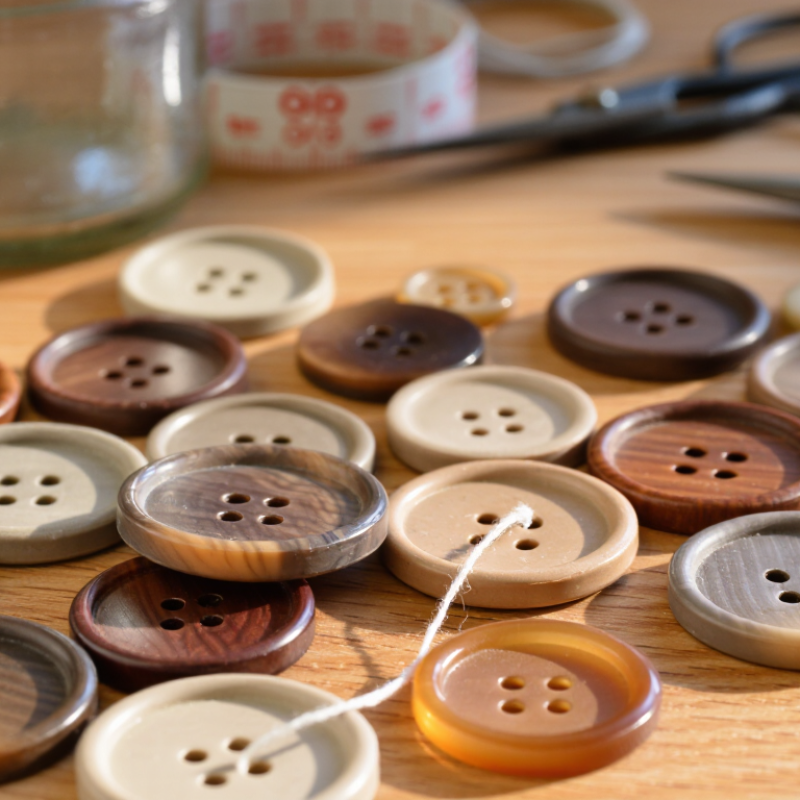
Horn buttons are made from 100% natural horn by-products, not plastic. These pieces come from animals already processed for food, helping use more of the available material. Horn is a keratin-based material, similar to human fingernails. It can be cut, shaped, polished, and drilled into durable buttons. No petroleum-based plastic is needed.
The surface often shows subtle lines, color shifts, and cloudy areas. These details are natural. They also make every button slightly different. In production checks, buyers should inspect button thickness, hole placement, edge smoothness, and polish consistency. A warm, earthy scent may appear during cutting, but strong chemical odors deserve attention. The material should feel firm, not hollow or excessively light.
Reliable suppliers should explain their raw-material sources and processing methods. They should also provide clear size tolerances, sample approval, packing details, and quality records. Horn buttons can reduce dependence on synthetic trims, but “eco” should not be accepted without evidence. Processing still uses water, electricity, abrasives, and transport. That part is easy to overlook. For global buyers, honest documentation matters as much as appearance. Natural variation may increase sorting work, yet it can also create a more authentic finish for shirts, knitwear, coats, and accessories.
For horn buttons, an environmental claim needs clear evidence, not attractive wording. ISO 14021 provides principles for self-declared environmental claims. It does not award an independent product certificate. A responsible supplier should identify the claim, define its scope, and retain supporting records. For example, a claim about natural material should match purchasing records, production controls, and batch documentation. Horn color, polishing agents, coatings, and adhesives may change the assessment. “Eco” alone is too vague.
REACH compliance requires separate attention. If a supplied article contains a Candidate List SVHC above 0.1% by weight, communication duties may apply. The calculation can become difficult for complex products, so the button, coating, and attached components should be reviewed carefully. Ask for current SVHC screening, test methods, sample details, and a signed declaration. A single old report is not enough, because the Candidate List can change. Results should match the actual production batch.
Tips: Request the latest Candidate List check before ordering. Confirm whether testing covers dyes, coatings, and adhesives. Keep invoices, batch numbers, and laboratory reports together. In practice, suppliers sometimes confuse “no detected SVHC” with “no regulated substances.” That wording needs reflection. Detection limits matter, and laboratory results do not replace a proper legal assessment. A careful supplier explains uncertainty instead of hiding it.
China Top Eco Horn Buttons Supplier for Global Buyers
Horn buttons suit buyers seeking natural texture, durable performance, and lower material waste. Textile Exchange’s Materials Market Report 2024 records global fiber production at 124 million tonnes in 2023. That scale makes material selection important, even for small trims. Horn buttons use recovered animal byproducts rather than synthetic resin alone. Their environmental value still depends on responsible sourcing and clear processing records.
Available sizes run from 11.5 to 25 mm. Common options include 15, 18, 20, and 23 mm. Thickness usually ranges from 2 to 4 mm. Two-hole and four-hole designs support shirts, jackets, knitwear, and heavier outerwear. A 2 mm button feels light and refined. A 4 mm button offers stronger visual weight. Measurements should be checked with a caliper, not by eye.
Practical inspection matters. Buyers should confirm hole diameter, hole spacing, edge smoothness, color consistency, and pull strength before approval. Natural horn may show small shade changes, fine lines, or uneven grain. That is not automatically a defect. However, excessive cracking suggests weak sorting or poor polishing. The weak point is often overlooked: a beautiful surface cannot repair inaccurate drilling. The supplier should provide pre-production samples, batch photos, and inspection records. ISO 3758 supports standardized textile care labeling, but it does not certify a button as eco-friendly. That claim needs evidence.
For global buyers, auditing a China eco horn button supplier requires more than checking product photos. MOQ should be confirmed by size, finish, color, and packaging. A 1,000-piece MOQ may apply only to one stable color. Mixed colors can raise setup costs. Ask for a written quotation.
Lead time needs a clear breakdown. Sample approval may take seven days, while production may require three to five weeks. Confirm whether inspection and export preparation are included. Delays often start with late artwork approval or unclear color standards. Small details matter.
AQL 2.5 should appear in the inspection plan, not only in the contract. It defines an acceptance level for sampled defects. It does not mean every button is perfect. Inspectors should check surface cracks, uneven drilling, color variation, sharp edges, and incorrect dimensions. Request the sampling method and inspection report. Batch traceability should connect each carton to a production lot, raw material record, inspection date, and packing list. Lot labels should remain readable after handling. A clean spreadsheet can still hide weak records. I would also request random carton photos before shipment. This step is simple, but suppliers may resist it. That resistance deserves attention. My audit checklist once overlooked rework records, which created confusion during a later quality review. Supplier controls should be tested, not merely promised.
China Top Eco Horn Buttons Supplier for Global Buyers
Global Compliance: CPSIA Limits Lead to 90 ppm and Phthalates to 0.1%
Eco horn buttons need more than an attractive natural finish. For children’s apparel and accessories, buyers should verify lead and phthalate controls before production. CPSIA requirements commonly reference a 90 ppm lead limit for surface coatings and a 0.1% limit for restricted phthalates. Exact obligations can vary by product, age range, and market.
Our quality process begins with controlled raw material selection. Each horn button batch receives a traceable code, visual inspection, and laboratory testing when required. Testing should cover lead, phthalates, and other substances relevant to the finished product. An independent laboratory operating under ISO/IEC 17025 provides stronger evidence than a supplier declaration alone. Small details matter, including polishing compounds, dyes, adhesives, and packaging contact.
A certificate is not enough. Material changes can affect results.
We have learned that natural materials require extra attention. Color, density, and surface treatment may differ between batches. That variation can complicate risk assessment. Buyers should request current reports, production samples, and written declarations before approving bulk orders. Retesting is wise after changing suppliers, coatings, or manufacturing processes. No inspection can replace careful documentation, but incomplete records remain a preventable weakness. Reliable sourcing depends on transparent testing, stable specifications, and honest communication when a result needs further review.
| Compliance or Product Dimension | Requirement or Reference Value | Application to Horn Buttons | Recommended Verification |
|---|---|---|---|
| CPSIA lead in surface coatings | Maximum 90 ppm (0.009%) in paint or surface coating. | Relevant to painted, printed, dyed, or coated button surfaces supplied for products covered by the U.S. Consumer Product Safety Improvement Act. | Lead testing by a laboratory following applicable CPSC-recognized methods. |
| CPSIA lead in accessible substrate | Maximum 100 ppm (0.01%) where the applicable children’s product substrate requirement applies. | Applies to the horn material and other accessible component materials when the finished product falls within CPSIA scope. | Representative substrate analysis using an accredited testing laboratory. |
| Restricted phthalates | 0.1% (1,000 ppm) maximum for each regulated phthalate in applicable accessible plasticized components. | Most relevant to plastic coatings, flexible trims, adhesives, or attachments; untreated horn itself is not a plasticized material. | Phthalate screening for DEHP, DBP, BBP, DINP, DIDP, and DnHP where applicable. |
| Material composition | Natural keratin-based animal material; composition may vary by source and processing. | Horn buttons can use an animal by-product and may reduce reliance on newly manufactured petroleum-based plastic components. | Material declaration, supplier traceability records, and product specification review. |
| Surface finish | Finish may be natural, polished, dyed, lacquered, or coated. | The finish can affect chemical compliance, color stability, abrasion resistance, and the applicable test scope. | Review the exact finish formula and test the finished button rather than relying only on raw-material data. |
| Dimensional tolerance | Tolerance should be agreed in the purchase specification; natural materials commonly require a defined size tolerance. | Button diameter, thickness, hole diameter, and hole spacing should be checked against the approved sample. | Caliper measurement and batch inspection using an agreed AQL or inspection plan. |
| Mechanical performance | Performance depends on button thickness, hole design, processing, and end-use requirements. | Buttons intended for children’s apparel or products require additional assessment of attachment strength and small-parts risks. | Pull-strength, torque, and sharp-edge checks according to the finished-product standard and use case. |
| Animal-origin documentation | Import requirements vary by destination, species, source, and product classification. | Buyers should confirm whether customs, veterinary, wildlife, or species-protection documentation is required. | Obtain country-of-origin information, species/source declarations, and destination-country import guidance. |
| Batch traceability | Each production lot should be identifiable through records and retained samples. | Natural variation in color, grain, density, and shape makes lot-level documentation particularly important. | Maintain lot numbers, production dates, inspection records, test reports, and approved reference samples. |
Note: CPSIA limits depend on the product category, component accessibility, finish, and intended use. The 90 ppm limit applies to lead in surface coatings, while the applicable children’s-product substrate limit is 100 ppm. Buyers should confirm the current requirements for the destination market and finished product.
No. It guides self-declared environmental claims. Evidence must support the exact claim and its scope.
Keep purchasing records, production controls, batch documents, and processing details. Color, coatings, adhesives, and polishing agents may affect the assessment.
By itself, very little. The supplier should define the material, process, evidence, and limitations behind the wording.
Communication duties may apply when a Candidate List SVHC exceeds 0.1% by weight. The button and attached components need careful review.
Request the latest Candidate List check, test methods, sample details, and a signed declaration. One old report is not enough.
No. Detection limits matter. Laboratory results support assessment but do not replace a proper legal review.
Sizes range from 11.5 to 25 millimeters. Thickness usually ranges from 2 to 4 millimeters.
Use a caliper to check size and thickness. Inspect hole spacing, edge smoothness, color consistency, and pull strength.
Not always. Natural horn may show uneven grain and small shade changes. Excessive cracking suggests weak sorting or poor polishing.
Ask for physical samples, batch photos, inspection records, invoices, and laboratory reports. Keep them together. Beautiful surfaces can still hide inaccurate drilling.
Eco Horn Buttons offer a natural and responsible alternative to plastic fasteners, being produced from 100% horn by-products recovered from existing agricultural supply chains. Their material story can be supported through clear environmental documentation, including ISO 14021-based claims and screening against REACH requirements, particularly the 0.1% threshold for Substances of Very High Concern (SVHC). Available specifications commonly include diameters from 11.5 to 25 mm, thicknesses of 2 to 4 mm, and two- or four-hole configurations, allowing use across a wide range of apparel and accessory designs.
For global buyers, supplier evaluation should cover minimum order quantities, production lead times, AQL 2.5 inspection procedures, and reliable batch traceability. Export readiness also requires attention to applicable product-safety standards, including CPSIA limits of 90 ppm for lead and 0.1% for restricted phthalates. Consistent testing, accurate records, and transparent quality control help ensure dependable sourcing and regulatory compliance across international markets.
Fangyuan Metal Button