Sourcing Buffalo Horn Buttons in 2026 requires more than comparing catalog prices. Buyers must examine origin, consistency, workmanship, documentation, and supplier reliability. Natural horn varies in color, density, grain, and translucency. That variation gives each button character, but it can also disrupt a carefully planned collection.
Elena Rossi, a natural-materials sourcing consultant with more than 20 years of factory experience, explains: “A good horn button is not only beautiful; it is traceable, stable, and honest about its natural variation.” Her point matters when reviewing suppliers. Ask for recent production samples, not only polished photographs. Hold the buttons under daylight. Check the edges for chips, the surface for shallow cracks, and the back for uneven drilling. A faint organic scent may be normal, but strong chemical odor deserves investigation.
Small details matter.
Reliable sourcing also means confirming the material’s legal and commercial status in both exporting and importing markets. Request origin records, product specifications, testing information, and clear statements about processing methods. Buffalo horn is commonly sourced as an animal by-product, yet requirements can differ by destination. Do not assume a supplier’s verbal assurance is enough.
A practical 2026 sourcing plan should compare sample quality, minimum order quantities, color grading, production capacity, packaging, lead times, and replacement policies. Some suppliers promise uniformity that natural horn cannot deliver. That is a warning sign. I have found that the “best” supplier is not always the cheapest. Sometimes, the most expensive mistake is an attractive sample that cannot be reproduced at scale.
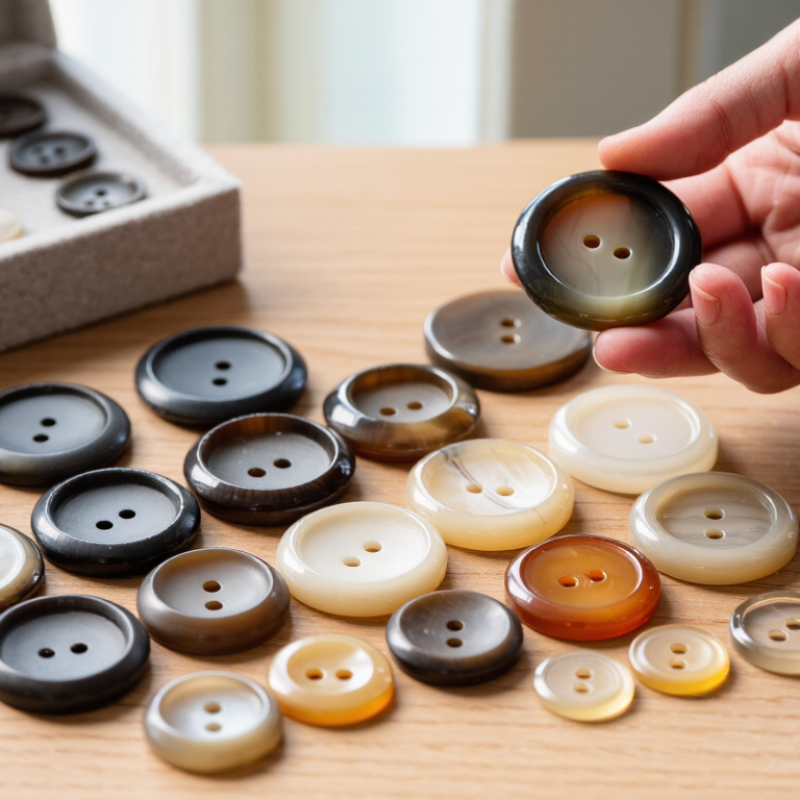
Buffalo horn buttons are natural garment fasteners made from recovered horn, usually from domestic water buffalo. They are not plastic imitations. Each button can show cloudy layers, fine lines, or warm brown shading. No two pieces look exactly alike. Some may include tiny pits or uneven edges. That variation is part of the material’s character, but it can also create quality problems.
FAOSTAT’s 2023 livestock data records more than 200 million buffalo worldwide. This suggests broad raw-material availability, yet supply is not automatically traceable. Ask suppliers for the animal species, processing country, and proof that the horn comes from lawful domestic livestock. The Textile Exchange Materials Market Report 2024 estimates global fiber production reached 124 million tonnes in 2023. That figure highlights the wider apparel industry’s growing need for credible material information, including small components such as buttons. Request batch photos, size measurements, polishing details, and defect allowances before ordering.
Use buffalo horn buttons on jackets, knitwear, shirts, and premium accessories. They suit earthy palettes and matte fabrics particularly well. Their density gives a firm, cool touch. However, excessive heat, strong solvents, and prolonged soaking may damage the surface. I would test them after dry cleaning and repeated fastening. Small samples can mislead. Ask for production samples, not only catalog pieces. Documentation may still be incomplete in some supply chains, so treat impressive claims carefully. “Natural” does not always mean responsibly sourced.
Ask for the source region, processing location, factory address, and material declaration. Request batch photographs and recent inspection records. The horn should be a documented animal byproduct. A polished website is not enough.
Examine samples under natural daylight. Genuine horn often shows irregular depth, fine grain, and slight tonal changes. Perfectly uniform patterns may suggest heavy treatment or imitation material. Look closely.
Sizes around 15L–18L often suit shirts. Sizes around 20L–24L can work for jackets. Larger buttons create more cutting waste. That cost is easy to overlook.
A satin finish preserves visible grain and looks less reflective. Polished surfaces feel smoother and reflect more light. Matte finishes may hide small marks but appear uneven between batches. Finish affects rework risk.
Standard buttons may cost about US$0.08–0.35 each. Larger, polished, or custom-cut pieces may cost about US$0.40–1.20 each. These figures are indicative, not fixed market averages. Confirm drilling, sorting, polishing, and packing charges.
Order at least 30 mixed samples for broader testing. For production approval, request three to five pieces from the proposed method. Test sewing, abrasion, dry cleaning, and color consistency. One perfect sample can mislead you.
Confirm diameter, thickness, hole diameter, hole spacing, and shrinkage data. A tolerance such as ±0.3 millimeters can provide a practical starting point. Measure with calipers, not photographs. I once trusted pictures too much.
Compare production pieces with one signed reference sample. Inspect buttons from different cartons, not only the top layer. Check cracks, sharp edges, odor, hole strength, color, and attachment performance. Record lighting conditions and measurements.
Sourcing Buffalo Horn Buttons in 2026 requires a clear understanding of their natural characteristics, common applications, and production limitations. These buttons are valued for their distinctive patterns, subtle color variation, durability, and suitability for apparel, accessories, and craft projects. Buyers should first define the intended use, preferred shape, thickness, color range, and finishing style before contacting suppliers.
A reliable sourcing process includes checking ethical documentation, material origin, responsible production practices, and compliance with applicable import and product regulations. Compare suppliers based on consistency, manufacturing capability, communication, minimum order quantities, lead times, and total pricing rather than price alone. Request samples to inspect surface quality, polishing, hole placement, dimensions, color variation, and resistance to normal handling. Before placing the final order, confirm approved specifications, packaging, delivery terms, inspection procedures, and replacement policies in writing. This careful approach can help buyers secure Buffalo Horn Buttons that meet both aesthetic expectations and practical quality requirements.

 Fangyuan Metal Button