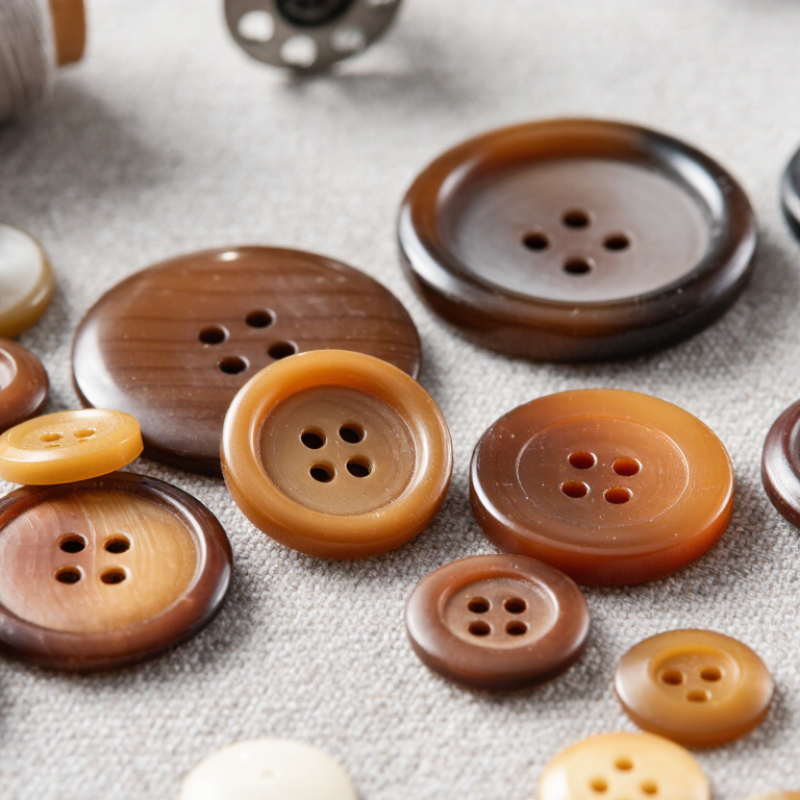
Real Horn Buttons offer a distinctive finish that synthetic alternatives often struggle to reproduce. Their natural grain, warm color shifts, and subtle surface depth can make a wool coat, heritage shirt, or handmade accessory feel more authentic. Each button is slightly different. That is part of the appeal.
For global sourcing, however, appearance should not be the only consideration. Experienced buyers examine material origin, supplier records, production capacity, and export documentation before placing larger orders. Responsible manufacturers should clearly explain whether the horn comes from lawful agricultural byproducts, rather than protected or restricted wildlife. Requirements can differ between countries, so importers must verify customs, environmental, and labeling rules with qualified authorities.
Quality control also needs practical attention. Ask for pre-production samples. Check button thickness, hole placement, edge smoothness, polish consistency, and resistance to cracking. A good sample should be tested against the actual fabric and washing conditions. Natural variation cannot be removed completely. Honestly, that can challenge strict color matching.
Reliable suppliers usually provide batch photos, inspection records, packaging details, and realistic lead times. Yet documents alone do not prove every claim. Independent verification, small trial orders, and clear acceptance standards reduce avoidable risks. Buyers should also discuss minimum quantities, replacement policies, and shipment protection before production begins.
Real Horn Buttons are not automatically the best choice for every product. Their value depends on design purpose, compliance needs, budget, and customer expectations. When sourcing is transparent and carefully checked, their natural character can support a credible, durable, and more responsible product story.
Why Choose Real Horn Buttons for Global Sourcing?
What Are Real Horn Buttons and How Are They Made?
Real horn buttons are made from the dense outer layer of cattle or buffalo horns. These horns are generally collected as livestock byproducts, not taken from protected wildlife. Responsible suppliers should provide clear origin records and follow animal welfare and trade regulations.
The manufacturing process begins with cleaning, trimming, and sorting the horn. Workers cut the material into suitable sections, then soften it with controlled heat. Pressure forms each piece into a button blank. After cooling, machines shape the edges, drill the holes, and polish the surface. The texture remains visible.
No two buttons are identical.
Natural horn contains subtle bands, cloudy areas, and changes in color. These details create a warm, tactile finish that plastic often cannot reproduce. However, they also make exact color matching difficult. This is a practical issue for large production orders. Buyers should approve physical samples before confirming bulk quantities.
Experienced sourcing teams also check thickness, hole placement, surface smoothness, and resistance to cracking. A button may look attractive but still fail during sewing or dry cleaning. Moisture, heat, and storage conditions can affect performance. I would not treat “natural” as proof of quality. Reliable inspection and traceable documentation still matter. Slight variation is expected, but careless sorting is not.
| Data Dimension | Verified Material or Production Information | Global Sourcing Consideration |
|---|---|---|
| Material Definition | Real horn buttons are made from the outer horn sheath of horned livestock, most commonly cattle or buffalo. The sheath is a natural keratin material, not plastic or synthetic resin. | Ask for a clear declaration of animal origin and confirm that the material is genuine horn rather than imitation horn or molded plastic. |
| Material Source | Horn is generally collected as a livestock by-product from animals processed for food. It is separated from the underlying bony core before button production. | Request documentation showing legal sourcing, traceability, and compliance with the import rules of the destination market. |
| Basic Composition | The horn sheath is composed primarily of alpha-keratin, the same broad structural protein family found in hair, wool, and fingernails. | Keratin gives the button a natural tactile feel and allows controlled shaping with heat and pressure, but it should not be treated as a completely uniform industrial material. |
| Initial Processing | After cleaning and separation, suitable horn sections are cut into pieces or blanks. The material is then heated and pressed or flattened so it can be formed into usable sheets or button shapes. | Manufacturing capability affects flatness, thickness consistency, color development, and the amount of usable material obtained from each horn. |
| Button Forming Process | Flattened horn material is commonly cut, punched, or machined into round, square, rectangular, or custom shapes. Holes are drilled or punched according to the design. | Provide approved drawings that specify diameter, thickness, hole count, hole spacing, edge profile, and allowable dimensional tolerance. |
| Finishing Process | Edges and surfaces are trimmed, sanded, buffed, and polished. Some products may receive additional surface treatment, while others retain a more natural matte or irregular appearance. | Define whether the required finish is polished, semi-matte, matte, engraved, or intentionally rustic, because finishing changes both appearance and cost. |
| Typical Commercial Sizes | Common apparel button diameters are approximately 10–30 mm, with thicknesses often around 1.5–4 mm. Actual ranges depend on the horn section, design, and end use. | Use millimetres in technical specifications and approve a physical sample before bulk production. Oversized buttons may have lower yield and greater natural variation. |
| Natural Color Range | Un-dyed horn may show cream, beige, brown, amber, grey, black, or mixed tones. Stripes, mottling, translucency, and tonal gradients are normal characteristics. | Set a color reference using physical standards or approved samples. A completely uniform color should not be expected from untreated natural horn. |
| Surface and Grain Variation | Natural horn can display differences in grain, translucency, density, polish response, and small visual markings. These variations are part of the material’s natural appearance. | Agree on acceptable and unacceptable defects, such as cracks, sharp edges, deep pits, delamination, burn marks, or structural weakness. |
| Performance Characteristics | Horn buttons are lightweight, rigid, and suitable for many apparel and accessory applications. Keratin can be shaped with controlled heat, but excessive heat may deform or damage the material. | Provide care and application requirements. Avoid exposing finished buttons to uncontrolled high temperatures during pressing, ironing, or industrial finishing. |
| Moisture and Care | Horn is a natural protein-based material and may be affected by prolonged moisture, harsh chemicals, strong solvents, or high heat. Normal garment use is generally acceptable when care instructions are followed. | For washable garments, conduct laundering and dry-cleaning tests using the actual button, thread, garment fabric, and finishing process. |
| Sustainability Profile | Using horn as a livestock by-product can help convert an existing animal-derived material into a durable product. This does not automatically make every product environmentally sustainable. | Evaluate the full supply chain, including collection, processing energy, water use, waste handling, packaging, transportation, and end-of-life options. |
| Animal-Origin Compliance | Because horn is animal-derived, import, veterinary, customs, labeling, and product-safety requirements may differ by destination country and product category. | Check current destination-market requirements before shipment and retain origin, processing, and customs documentation for each order. |
| Quality-Control Checks | Typical inspections include material authenticity, diameter, thickness, hole position, hole size, edge smoothness, color consistency, surface finish, odor, cracks, and button strength. | Use an approved pre-production sample, a sealed color and finish standard, written tolerances, and a defined inspection plan for bulk orders. |
| Best-Fit Applications | Real horn buttons are commonly selected for shirts, jackets, coats, knitwear, leather goods, bags, footwear, and craft products that benefit from a natural premium appearance. | Select the button size, thickness, hole design, and finish according to the garment weight, attachment method, washing conditions, and required visual effect. |
| Main Sourcing Advantage | Each button can offer a distinctive natural pattern, tactile quality, and visual depth that are difficult to reproduce exactly with mass-produced synthetic materials. | Real horn is most suitable when natural variation is considered a design feature rather than a defect and when the buyer can manage sample approval and quality tolerances. |
Note: Dimensions and performance ranges are typical industry guidelines rather than universal specifications. Final requirements should be confirmed through approved samples and application-specific testing.
Real horn buttons offer a tactile difference that synthetic alternatives often struggle to reproduce. Their surface feels warm, not uniformly smooth, when handled. Each button may show subtle color shifts, fine grain, or small natural marks. These details can make a wool coat, linen shirt, or handmade cardigan feel less factory-made.
Synthetic buttons provide stronger consistency. Their size, color, and hole placement usually remain nearly identical across large production runs. They also offer broad color control and easier replacement planning. For high-volume orders, this predictability can reduce sorting time and production delays. Real horn can perform well, but it requires careful inspection. Excessive moisture, heat, or rough finishing may affect its appearance. That weakness matters in workwear and frequently washed garments. Testing samples under actual use is essential.
The choice also involves sourcing discipline. Responsible buyers should request material descriptions, production details, and traceability records for legally sourced horn products. “Natural” does not automatically mean sustainable. Suppliers should explain how waste material is handled and how quality is checked. Synthetic options may be more uniform and affordable, yet some may feel colder or appear overly glossy. Real horn is not perfect. Its variation can create extra labor and occasional rejection. Still, for premium garments, that variation may become part of the product’s character. Small differences matter.
Why Choose Real Horn Buttons for Global Sourcing?
Real horn buttons offer a distinctive material story for international apparel and accessory sourcing. Their natural grain, soft sheen, and warm color variation create a tactile finish that plastic often cannot reproduce. Each button may show subtle differences. That is part of the appeal.
For sourcing teams, durability is another practical benefit. Properly finished horn can resist everyday wear and maintain a comfortable hand feel. It also supports premium positioning without adding unnecessary visual decoration. Experienced buyers should request production samples, not rely on photographs. Sample checks can reveal uneven polishing, inconsistent drilling, or color changes between batches. Small defects become expensive when they reach large-scale production.
Traceability matters. Reliable suppliers should provide clear information about material origin, processing, and lawful trade documentation. Import requirements may differ by destination, especially when animal-derived materials are involved. Species identification and supporting records deserve careful review. Never assume that “natural” means automatically compliant. That assumption can create delays. Packaging, moisture protection, inspection standards, and replacement terms should also be agreed in writing. Real horn is not perfectly uniform, and that can complicate exact color matching. Some buyers may see this as a weakness. Others use the variation as evidence of authenticity, while still setting reasonable quality limits.
Real horn buttons offer natural color, subtle grain, and a warm touch that synthetic materials often imitate poorly. Yet appearance alone cannot prove quality. Buyers should inspect surface polish, button thickness, hole alignment, and edge finishing. A well-made button should feel smooth, not brittle. Small cracks around the holes may appear after sewing or washing. That detail is easy to miss during sampling. Request production samples, not only photographs, because lighting can hide uneven texture.
Ethical sourcing requires clear documentation. Ask whether the horn is a lawful byproduct of regulated livestock processing. Suppliers should explain the material’s origin, processing location, and traceability records. Local import rules may also require specific declarations. Sustainability claims deserve careful questioning. Horn can reduce waste, but processing still uses water, heat, and energy. Request information about polishing compounds, wastewater handling, and packaging. No checklist is perfect. Buyers should record assumptions and review them when regulations or supplier conditions change.
Tips: Compare samples under natural light. Test rubbing, moisture, and repeated buttoning. Check for odor, color transfer, and sharp edges. Keep supplier records. If documentation feels vague, pause the order and ask for evidence. A lower price may reflect thinner material or weaker controls, not better sourcing.
Real horn buttons can offer natural color variation, dense texture, and a warm surface that synthetic materials rarely reproduce. Their cost begins with the raw material. FAOSTAT livestock data records more than 1.5 billion cattle worldwide, but cattle numbers do not equal button supply. Horns must be collected, cleaned, stabilized, cut, and graded before production. That conversion creates waste. A curved horn may produce only a limited number of uniform blanks.
Labor and yield often matter more than the raw horn itself. Small workshops may shape each button individually, while larger facilities use standardized cutting and polishing processes. Size, thickness, color consistency, drilling precision, and surface defects also change the price. The OECD-FAO Agricultural Outlook 2024–2033 indicates continued growth in global meat production, which may support future by-product availability. Still, supply can remain uneven because collection networks and processing capacity differ by region. This is where a buyer can misjudge the market.
Import requirements need careful verification. The product may fall under HS 9606.29, covering buttons made from materials other than plastics, but customs treatment varies by country and composition. The International Trade Centre recommends checking current tariff and classification data before shipment. Animal-origin materials may require sanitation records, origin documents, or authority review. Protected-species rules can also apply if the material is misidentified. Use domestic cattle or buffalo sources with traceable paperwork. Do not rely on a supplier’s casual description. That shortcut can become an expensive delay.
They come from the dense outer layer of cattle or buffalo horns. These horns are usually livestock byproducts. Responsible suppliers should provide origin records.
Workers clean, trim, and sort the horn. Controlled heat softens each section. Pressure forms blanks, then machines shape, drill, and polish them.
Natural horn contains bands, cloudy areas, and changing shades. No two buttons are identical. Exact color matching can be difficult.
Inspect thickness, hole alignment, smooth edges, and surface polish. Look closely around the holes. Small cracks may appear later.
No. Request physical production samples. Compare them under natural light. Lighting can hide uneven texture and weak polishing.
Test repeated buttoning, rubbing, moisture, and washing conditions. Check for odor, color transfer, sharp edges, and brittleness. Some problems appear only later.
Not necessarily. Natural texture is attractive, but careless sorting can reduce performance. I would not treat “natural” as proof of quality.
Ask whether the material comes from lawful livestock processing. Request origin, processing, traceability, wastewater, and packaging information. Sustainability still has limits.
Labor, material yield, thickness, size, color consistency, and drilling precision affect pricing. Curved horns may produce few uniform blanks. A low price deserves questions.
Verify the current customs classification and local import rules. Animal-origin materials may need sanitation or origin documents. Do not rely on casual supplier descriptions.
Real Horn Buttons are natural fastening components made from horn material that is cleaned, cut, shaped, polished, and carefully finished into different sizes and designs. Their organic grain, subtle color variation, and smooth feel give garments and accessories a distinctive character that synthetic alternatives may not fully reproduce. Compared with plastic or resin buttons, horn buttons can offer a more natural appearance, durability, and a premium tactile experience, although their variation requires more careful quality control.
For global sourcing, buyers should assess material origin, processing standards, consistency, surface quality, sizing accuracy, and supplier transparency. Ethical purchasing depends on verifying responsible sourcing and ensuring that the material is obtained through permitted, traceable channels. Sustainability should be evaluated realistically, including production waste, packaging, and long-term product use. Costs may change according to horn type, craftsmanship, order volume, availability, customization, and transportation. Importers should also confirm labeling, documentation, customs classification, and destination-market requirements before placing an order.

Fangyuan Metal Button